





- by Madeline Staples
Best Weed Storage Containers: Keep Cannabis Fresh Longer
- by Madeline Staples
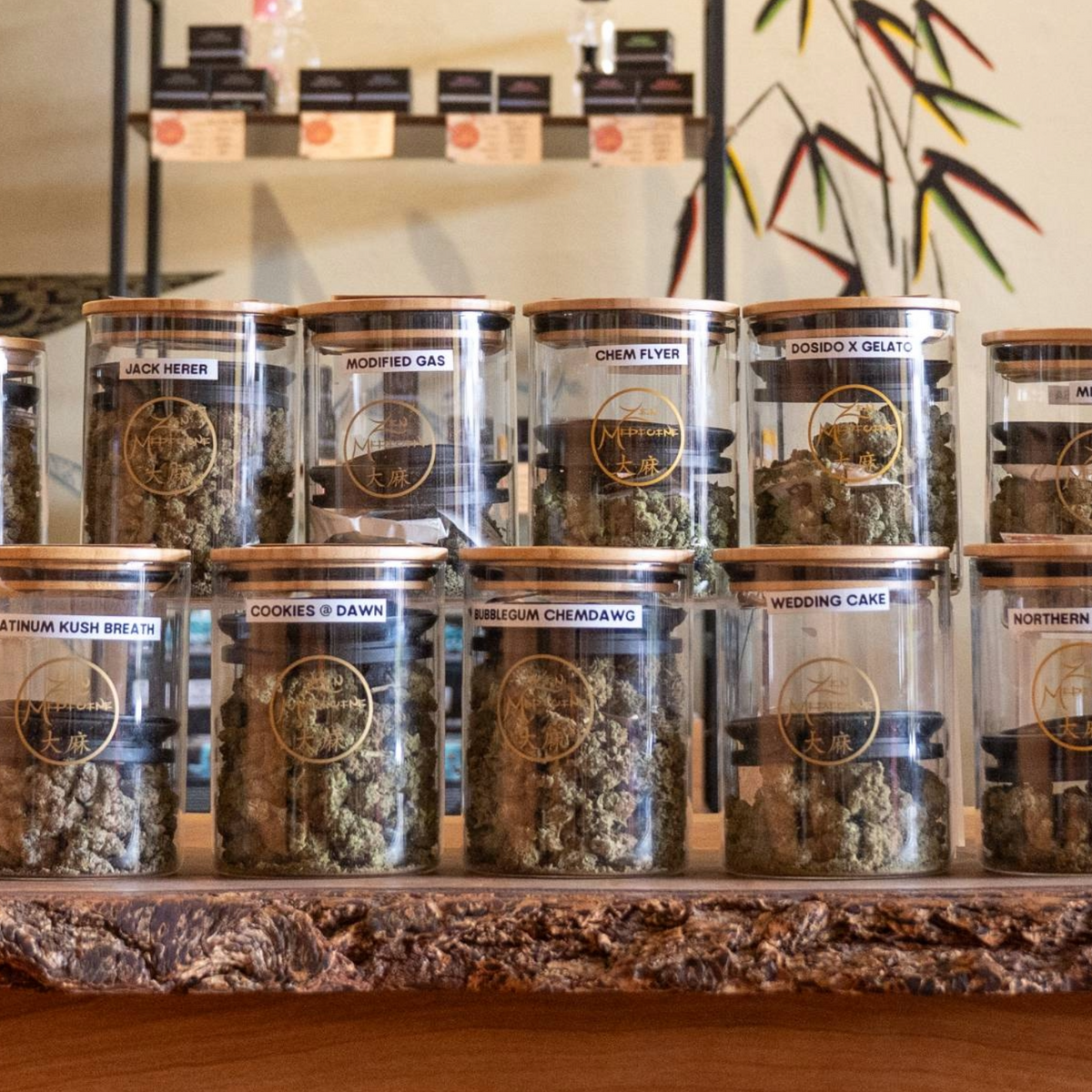
The best weed storage containers remove oxygen through an airless valve system, block UV light with opaque or smoked materials, and maintain humidity between 58-62% using two-way packs. This combination reduces THC degradation and preserves terpenes, the aromatic compounds that define each strain's character.
This guide is for cannabis enthusiasts who treat flower the way coffee lovers treat single-origin beans: you buy in small, expensive quantities, you care about preserving aroma and effect, and you're tired of dispensary pop-tops that dry product to dust within weeks.
You'll learn:
Four factors break down stored flower, and they're not the same ones that ruin coffee or tea. Getting this distinction right determines whether your cannabis stays fresh for months or loses potency in weeks.
Oxygen oxidizes cannabinoids and volatilizes terpenes. Exposure to air is the primary enemy. THC breaks down into CBN, a less psychoactive compound, and the aromatic terpenes that carry flavor and strain character evaporate. A 2026 buyer's guide confirms that quality airtight jars with UV-blocking glass or silicone gasket sealing can keep flower fresh for 6 to 12 months when stored properly with humidity control.
Light degrades THC directly. UV exposure accelerates cannabinoid breakdown, which is why clear glass on a windowsill is the worst storage option. Effective weed storage containers use UV-blocking borosilicate glass, smoked tops, or opaque stainless steel. Recent 2026 cannabis packaging data shows that light-blocking glass jars and opaque containers accounted for 67% of flower packaging by 2026.
Humidity requires a maintained band, not complete dryness. This is where cannabis diverges sharply from coffee, tea, and pantry goods. Those substrates want bone-dry storage because any moisture causes spoilage. Cannabis does not. Flower stored too dry becomes brittle, harsh, and loses terpenes. Stored too wet, it grows mold. Cannabis needs a maintained moisture range, which is why serious storage setups include two-way humidity packs that add or remove moisture as needed.
Heat accelerates all of the above. Warm storage speeds oxidation, cannabinoid degradation, and terpene loss. The solution is cool, dark, sealed, and humidity-stable storage, not refrigeration, which introduces condensation problems.
Most airtight containers seal around a headspace of oxygen that sits against your flower. Airless valve systems remove that oxygen first, creating active preservation instead of passive containment.
The mechanism is a two-lid system. The outer lid closes the container. The inner lid is the working component: it descends directly onto the contents, forcing air out through a one-way valve as it goes. This physically evacuates oxygen rather than trapping it inside.
The valve is one-way, so air leaves but doesn't return. It's also self-degassing, which matters for cannabis because fresh flower continues to off-gas CO2. A fully rigid airtight seal builds pressure. An airless valve system lets the jar self-burp without you opening it and admitting oxygen back in.
Cannascape® applies this same airless preservation engineering we built for coffee storage to cannabis, where the stakes are higher: flower is bought in small, expensive quantities and degrades visibly in aroma, flavor, and effect within weeks of leaving a dispensary container.
The mechanism is entirely mechanical, no pump, motor, or battery. You press the inner lid down by hand, the valve exhausts the air, and the seal holds until you lift the lid again.
Material choice affects light exposure, odor containment, durability, and whether the container itself contaminates what's stored inside.
Restaurant-grade 18/8 stainless steel blocks light completely, doesn't absorb odors or stains, and lasts for years without degrading. A 2026 buyer's guide lists premium stainless steel containers at $40 to $80, positioning them as the most durable long-term option.
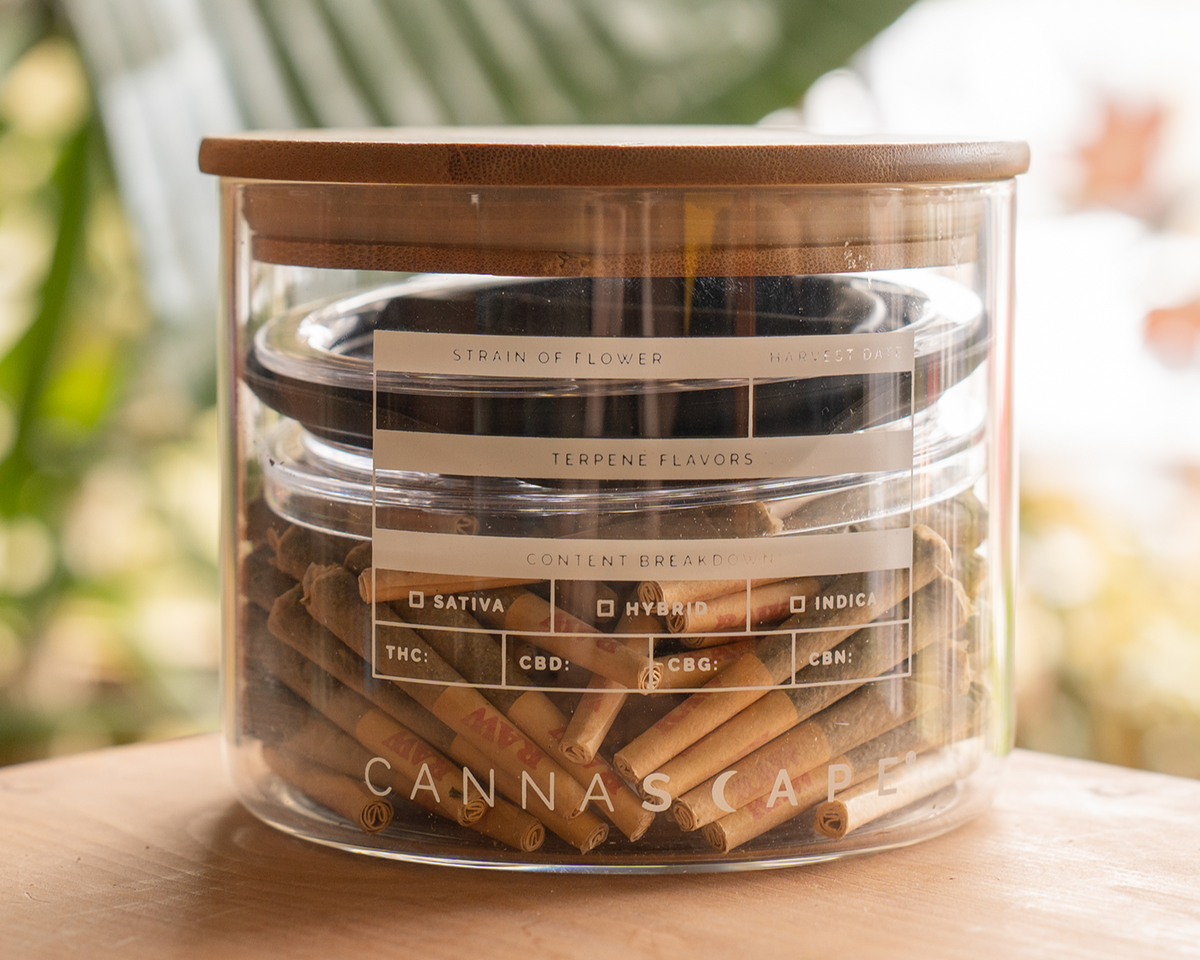
The Cannascape® Stainless Steel Stash Jar holds up to 2 ounces of flower in a 4-inch opaque body with a smoked top lid over the airless inner plunger valve. It's available in matte Chalk (white) and matte black. The jar is BPA free, hand wash only, and includes a built-in writable strain table for logging strain name, harvest date, terpene profile, and potency.
Borosilicate glass resists thermal shock, doesn't leach chemicals, and won't absorb odors the way plastic does. UV-blocking or smoked glass adds light protection without sacrificing the ability to see contents at a glance. Recent 2026 product rankings increasingly favor UV-filtering glass combined with silicone gasket seals.
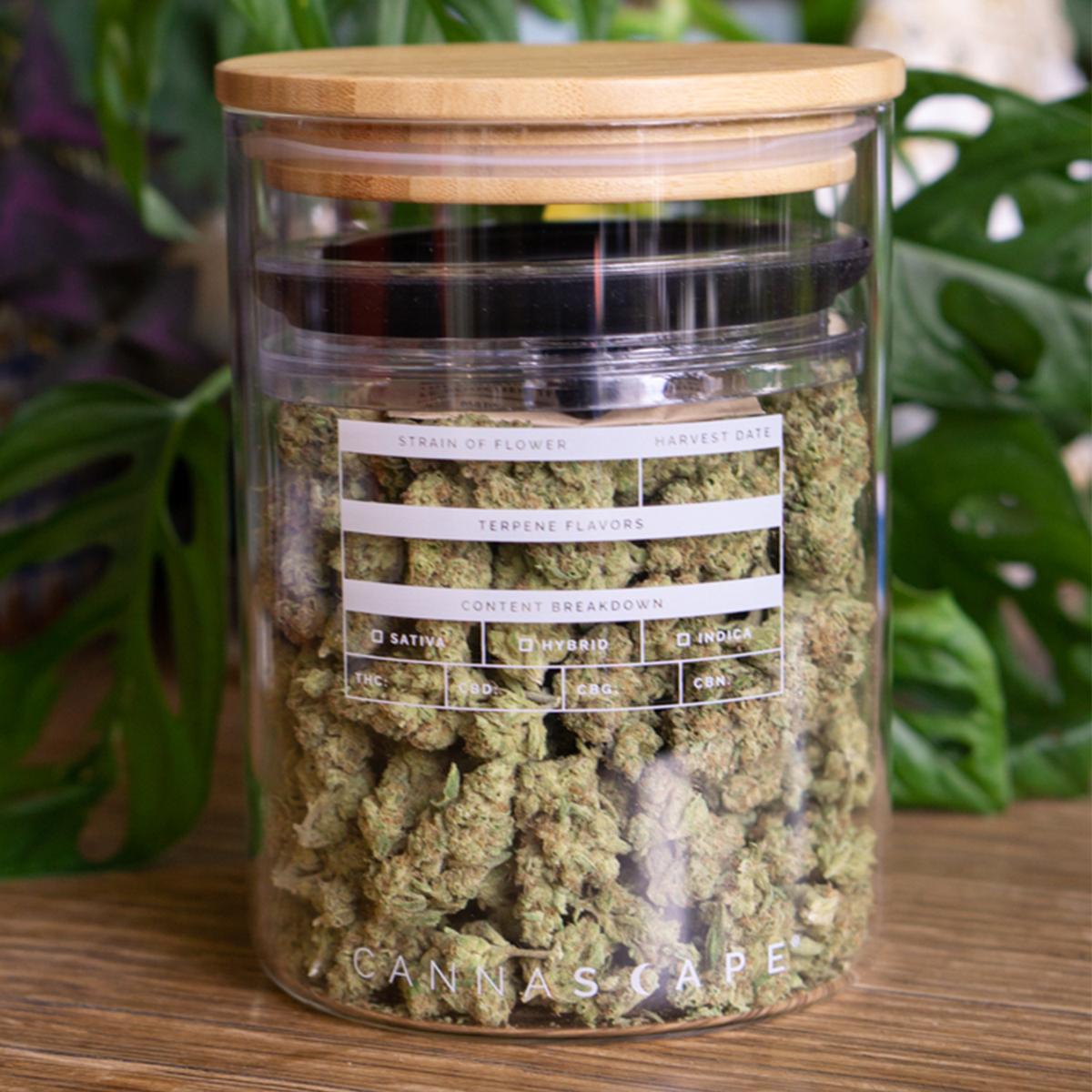
The Cannascape® Glass Stash Jar uses borosilicate glass with a bamboo top lid over the same airless inner plunger valve. It's available in 4-inch and 7-inch sizes, holding up to 3.5 ounces of flower. Like the stainless version, it's BPA free, hand wash only, and includes the writable strain table.
Plastic is acceptable only for short transport periods under one week, according to a 2026 storage guide. Over time, plastic absorbs odors, scratches easily (creating hiding spots for residue and bacteria), and can leach chemicals depending on the grade. A jar that permanently smells of the last strain stored in it is a real failure mode.
Cannabis needs a maintained moisture band, neither bone dry nor damp. The target is 58-62% relative humidity. Below that, flower becomes brittle and terpenes evaporate. Above that, mold risk increases.
Two-way humidity packs solve this by adding or removing moisture as needed. Boveda® packs are the most commonly recommended option. They contain a salt solution that releases or absorbs water vapor to maintain a specific RH level, creating a protective layer over trichomes.
A 2026 buyer's guide lists humidity-pack jar setups at $30 to $40 and confirms that multiple guides agree the best storage performance comes from airtight glass or stainless steel with silicone gaskets, combined with 58-62% humidity packs and cool, dark storage.
Cannascape® jars are sized to work with Boveda® Size 8 packs, which fit inside without taking up excessive space. The airless valve system complements humidity control by removing the oxygen that would otherwise accelerate moisture-related degradation.
Smell-proof performance depends on gasket quality and seal design, not just whether the lid screws on tight. Cannabis aroma comes from volatile terpenes, small molecules that escape through gaps most people don't notice until they walk into a room and immediately smell what's stored inside.
Effective odor containment requires a continuous silicone or rubber gasket that compresses evenly around the entire seal perimeter. The seal needs to be airtight in the literal sense: if air can't escape, terpene molecules can't either.
Cannascape's airless valve system creates odor resistance as a byproduct of oxygen removal. The inner plunger lid sits directly on the contents with a one-way valve that exhausts air but doesn't allow it back in. The outer lid then seals the top. This two-stage approach addresses both preservation and containment.
That said, no container is 100% odor-proof under all conditions. Absolute odor claims aren't substantiable. What matters is whether the jar performs well enough to sit on an open shelf without announcing what's inside, and whether it holds up to repeated opening and closing without the gasket degrading.
Travel storage prioritizes compactness, durability, and discrete appearance over maximum capacity. A 2026 guide highlights smell-proof, lockable compact boxes and Mylar-plus-hard-case setups as dedicated travel options.
For short trips, look for containers that fit in a pocket or bag without rattling, won't crack if dropped, and don't look like cannabis storage at first glance. Stainless steel outperforms glass for portability because it's lighter and won't shatter.
For longer trips where you're storing flower in a cabin, hotel, or vehicle, the same preservation principles apply: airtight seal, light blocking, humidity control. The Cannascape® Stainless Steel Stash Jar's 4-inch size holds up to 2 ounces in a form factor that travels well while maintaining the airless valve seal that prevents degradation.
One consideration specific to travel: argon gas canisters like Airgone® can't ship to PO boxes, Alaska, Hawaii, or most destinations outside the US and Canada. If you're using Fresh-Port® technology with inert gas flushing, plan accordingly.
Fresh-Port® technology lets you flush inert gases, specifically argon, onto moisture-sensitive contents for added protection. Argon is heavier than oxygen, non-reactive, odorless, tasteless, and food-safe. A 2-second flush through a Fresh-Port® valve lid lays a barrier between the contents and any remaining oxygen.
Both Cannascape® jar lines support Fresh-Port® technology. Airgone® Argon Gas comes in a pressurized canister that delivers roughly 75 flushes per unit. It's sold individually at $14.95 or as a bundle starting at $26.99.
The process is straightforward: open the outer lid, press the argon nozzle into the Fresh-Port® valve, spray for 2 seconds, close the outer lid. The argon settles over the flower, displacing oxygen. Combined with the airless inner plunger lid, this creates a double-layer preservation system.
This approach is overkill for daily-use jars you open frequently. It makes sense for long-term storage: holding a rare strain you're saving, preserving flower you won't touch for months, or protecting product in a humid environment where you're concerned about moisture and oxidation both.
Short-term storage is for flower you'll consume within a few weeks. The priority is convenient access and basic freshness preservation. A simple airtight jar with a silicone gasket and a humidity pack is sufficient. You're not fighting months of oxidation, you're just keeping the product from drying out between uses.
Long-term storage is for flower you're holding for months, whether because you bought in bulk, you're saving a favorite strain, or you're curing flower you grew yourself. Here, every degradation factor compounds over time. Oxygen exposure that wouldn't matter over two weeks destroys terpenes over two months. Light that barely affects short-term storage visibly degrades cannabinoids over a season.
Long-term storage requires UV-blocking or opaque containers, airless or vacuum-seal systems, stable humidity control, and cool, dark placement. The Cannascape® line is designed for this use case: the airless valve removes oxygen mechanically, the stainless or smoked glass blocks light, and the jars are sized to work with humidity packs.
One detail that matters for long-term storage: the built-in writable strain table. When you're holding multiple strains for months, being able to log harvest date, terpene profile, and potency directly on the jar prevents the common problem of forgetting what's in which container.
Mason jars are better than dispensary pop-tops, but they're not optimized for cannabis storage. A standard mason jar with a metal lid and rubber gasket provides a decent airtight seal and costs less than purpose-built options. That's why they're a common starting point.
The limitations show up over time. Mason jars trap a headspace of oxygen against the flower. They don't block UV light unless you wrap them or store them in a dark place. The metal lids can rust if exposed to humidity. And the seal quality depends on the gasket condition, a worn gasket leaks air and odor.
If you already own mason jars and want to upgrade them, the Fresh-Port® Wide Mouth Mason Jar Lid converts them into airless storage for $16.00. This gives you the oxygen-removal benefit without replacing the entire jar. You'll still need to address light exposure separately, either by choosing amber glass jars or storing them in a dark cabinet.
Flower that dries out becomes harsh and loses terpenes. Flower that oxidizes loses potency: THC degrades into CBN, which has different effects. Flower stored in clear glass under light visibly yellows as cannabinoids break down. And flower stored in a container that doesn't seal properly announces itself across the room.
The financial cost is straightforward: if you buy an eighth for $40 and it's unpleasant to consume after two weeks because it dried to dust, you've wasted $40. If you buy an ounce in bulk to save money and half of it degrades before you use it, you've lost the savings.
The experience cost is harder to quantify but more frustrating. You bought a specific strain for its terpene profile and effect. Poor storage turns it into generic harsh smoke with muted aroma. You're not getting what you paid for.
Purpose-built weed storage containers cost more upfront (the Cannascape® Stainless Steel Stash Jar is $48.00, the Glass Stash Jar starts at $45.00), but they're bought once and used for years. A jar that preserves flower for 6 to 12 months instead of 2 to 3 weeks pays for itself quickly if you buy regularly.
Both stainless steel and glass jars are hand wash only. Use warm water and mild dish soap. Avoid abrasive scrubbers that can scratch the surface or damage gaskets.
Pay attention to the inner plunger lid and valve. Resin buildup can interfere with the valve's one-way function. Disassemble the lid components according to the product instructions, clean each piece separately, and let them dry completely before reassembling.
Inspect gaskets regularly. A gasket that's cracked, compressed flat, or visibly degraded won't seal properly. Replace it rather than trying to make a worn gasket work.
Don't put Cannascape® jars in the dishwasher. The high heat and harsh detergents can damage the valve mechanism and degrade gaskets faster.
Start with the preservation fundamentals: airtight seal, light blocking, humidity control support. If a container doesn't address all three, it's not built for long-term storage.
Check the seal design. Look for continuous silicone or rubber gaskets, not just threaded lids. If the product description mentions "airless" or "vacuum seal," verify whether it's a mechanical system (like an inner plunger lid) or just marketing language for a tight-fitting lid.
Consider material durability. Stainless steel and borosilicate glass don't absorb odors, don't stain, and last for years. Plastic is fine for short-term transport but degrades over time.
Think about size relative to how you buy. If you buy eighths and use them within a week, you don't need a 2-ounce jar. If you buy ounces in bulk, a jar that holds 3.5 ounces gives you room for flower plus a humidity pack without cramming everything in.
Look for features that make multi-strain storage practical: writable strain tables, color-coded lids, or clear sections that let you see contents without opening the jar.
And check whether the brand offers replacement parts. A $50 jar that requires complete replacement when a gasket wears out is less sustainable than a $50 jar with $5 replacement gaskets available.
Do weed storage containers really keep cannabis fresh longer?
Yes, when they address the four degradation factors: oxygen, light, humidity, and heat. A 2026 buyer's guide confirms that quality airtight jars with UV-blocking glass or silicone gasket sealing can keep flower fresh for 6 to 12 months when stored with humidity control in a cool, dark place. Containers that only seal without removing oxygen or blocking light provide shorter preservation.
Can you store different strains in the same container?
You can, but you shouldn't for long-term storage. Different strains have different terpene profiles, and storing them together causes cross-contamination of aromas. Each strain loses its distinct character. Use separate containers per strain, especially if you're holding flower for weeks or months. The built-in strain table on Cannascape® jars makes multi-strain organization practical.
How often should you replace humidity packs in cannabis storage?
Replace humidity packs when they become rigid or crystallized. A fresh two-way humidity pack feels like a gel packet. Once it hardens, it's no longer regulating moisture. Depending on how often you open the jar and how much flower you're storing, packs typically last 2 to 4 months, similar to how the caffeine content in tea varies based on storage and preparation conditions. If you're storing in a very dry or very humid environment, they'll deplete faster.
Is it better to store cannabis in the fridge or at room temperature?
Store at cool room temperature in a dark place, not in the fridge. Refrigeration introduces condensation problems when you remove the jar and it warms to room temperature. The moisture from condensation can cause mold. Cool, dark, and stable is better than cold and fluctuating. A cabinet or drawer away from heat sources works well.
What's the best container size for storing an ounce of cannabis?
A jar that holds up to 2 ounces gives you room for an ounce of flower plus a humidity pack without packing everything tightly. The Cannascape® Stainless Steel Stash Jar holds up to 2 ounces in a 4-inch form factor. The Glass Stash Jar's 7-inch size holds up to 3.5 ounces if you're buying in larger quantities or storing multiple strains' worth in one container with dividers.
The difference between weed storage containers that preserve flower for months and ones that let it degrade in weeks comes down to three factors: removing oxygen, blocking light, and maintaining humidity. Airless valve systems address the first by mechanically evacuating air rather than trapping it. Stainless steel and UV-blocking glass address the second. Two-way humidity packs address the third.
Cannascape® combines all three in jars designed for cannabis enthusiasts who treat flower the way coffee lovers treat single-origin beans. The airless inner plunger lid removes oxygen. The stainless or borosilicate glass body blocks light. The jars are sized to work with Boveda® humidity packs. And the built-in strain table makes multi-strain storage practical.
Shop the Cannascape® line and see how airless preservation keeps your cannabis fresh longer.
How to Store Pre-Rolls So They Don't Dry Out
How to Store Dry Dog Food: Keep Kibble Fresh to the Last Scoop
Sustainable Food Storage Containers That Actually Work
Glass vs Plastic Storage Containers: Which Is Right for You?
Best Way to Store Cannabis Buds: Complete 2026 Guide
Share:
Odor Proof Storage Containers: What Works and Why
How Much Caffeine in Different Teas: A Complete Guide