






- by Madeline Staples
How Many Scoops of Coffee Per Cup? A Measuring Guide for Every Brewer
- by Madeline Staples
Use one level coffee scoop (2 tablespoons) of ground coffee for every 6 ounces of water for a full-strength cup, or half a scoop for a milder one. That follows the National Coffee Association's Golden Ratio of 1 to 2 tablespoons per 6 ounces. A 12-cup drip pot, which holds about 72 ounces, needs roughly 6 to 12 level scoops depending on how strong you like it.
This guide is for anyone who brews by the scoop instead of the scale: the morning drip-pot crowd, the pour-over hobbyist who left the scale at home, and the camper measuring grounds by headlamp. If your coffee swings from weak to bitter for no obvious reason, the scoop is usually where the problem starts. We'll cover what a "scoop" actually holds, how many you need for each brew method and pot size, and how to keep your measurements consistent from the first scoop of the bag to the last.
Here's what we'll cover:
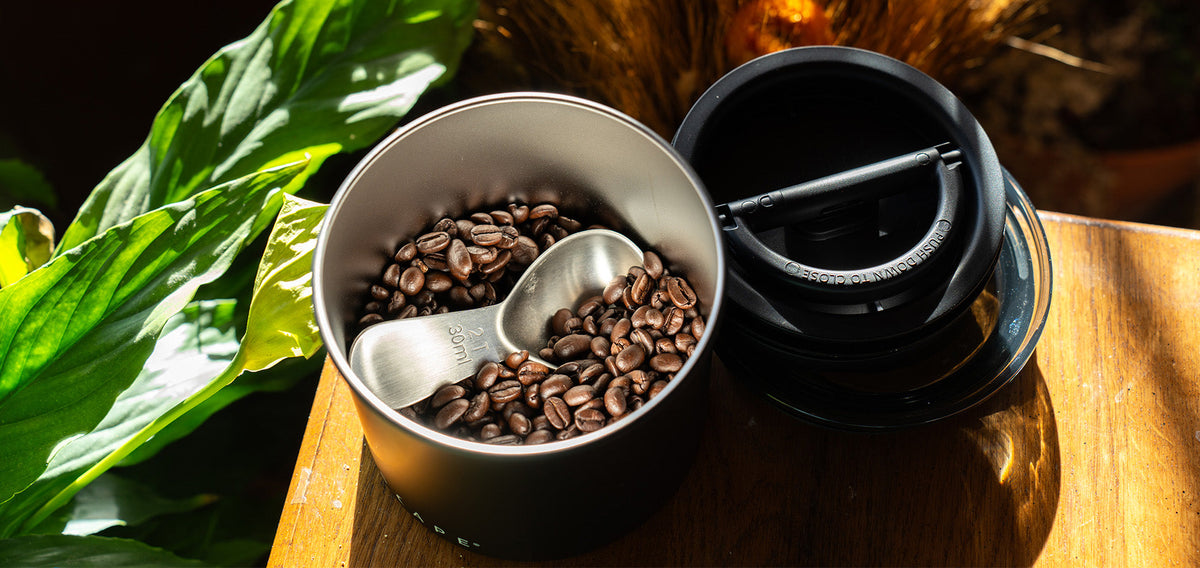
A standard coffee scoop holds 2 tablespoons. That's the measurement most brewing guides assume when they say "one scoop per cup," and it's what our stainless steel Coffee Scoop is built to hold.
The trouble is that not every scoop is standard. Scoops that come free with coffee makers or tucked inside bags of grounds range from about 1 tablespoon to well over 2. Some are shaped more like shallow spoons, and some are deep cups that pack grounds down as you dig. If you've ever followed a recipe exactly and still ended up with weak coffee, a mystery scoop is a likely suspect.
If you don't know what your scoop holds, test it. Fill it level with water and pour it into a tablespoon measure. Two full tablespoons means you have a standard scoop. Anything else, and you'll want to adjust the numbers in this guide or switch to a scoop with a known volume.
A level 2-tablespoon scoop of ground coffee weighs roughly 10 grams, though the exact number shifts with roast level and grind size. That lines up neatly with the Specialty Coffee Association's Golden Cup standard of 55 grams of coffee per liter of water, which works out to just under 10 grams for a 6-ounce cup. In other words, one level scoop per 6 ounces lands you very close to the specialty coffee benchmark.
Whole beans are a different story. They don't pack as tightly as grounds, so a scoop of whole beans usually weighs a bit less than a scoop of ground coffee. If you scoop beans and then grind, expect to need slightly more beans by volume to hit the same strength. A kitchen scale will settle the question for your specific beans in about thirty seconds.
This is where most measuring goes wrong. In coffee, a "cup" is 6 ounces of water, not the 8-ounce cup in your measuring set. The cup markings on most drip carafes are based on that smaller number, and the National Coffee Association's ratio is written per 6 ounces too.
Your mug is a different thing entirely. Most everyday mugs hold 10 to 14 ounces, and travel tumblers go higher. So if you brew "two cups" by the carafe lines and pour it into one big mug, you've really made one mug of coffee. Counting scoops by mugs instead of by 6-ounce cups is the fastest way to brew coffee that tastes thin.
The simplest fix is to measure your water in ounces and divide by six. That gives you the number of coffee cups you're brewing, and the scoop count follows from there.
For an automatic drip machine, start at about three-quarters of a scoop (1.5 tablespoons) per 6-ounce cup and adjust from there. The NCA's drip coffee guide gives the full 1 to 2 tablespoon range, and the middle of that range is a sensible place to begin for most medium roasts.
Drip machines are forgiving, but they're not magic. Grind matters as much as dose: the NCA recommends a medium grind, about the texture of kosher salt, for drip brewing. If your coffee tastes bitter with a normal scoop count, try a slightly coarser grind before you cut back on coffee. If it tastes flat, go a little finer.
Fill the carafe to the line you want, pour it into the reservoir, and count your scoops into the filter basket. Level each one off with a finger or the back of a knife. That small habit does more for consistency than any fancy machine setting.
Pour-over usually runs a little stronger than drip, so plan on one full level scoop per 6 ounces of water. A single-cup cone brewing 12 ounces takes about 2 scoops.
Because you're pouring by hand, you control the water temperature and flow, and that makes the dose easier to dial in. The sweet spot for water temperature is covered in our guide to pour-over coffee water temperature. Once your water is right, the scoop becomes your main tuning knob.
If you're brewing pour-over at camp, the scoop is often the only measuring tool you have. A sturdy stainless scoop that lives in your coffee canister means one less thing to forget. Pack it with a collapsible brewer and you've got a full setup that fits in a cook kit.
French press coffee is typically brewed stronger, so expect to use a bit more than one scoop per 6 ounces of water. For a standard 34-ounce (1-liter) press, that's around 6 to 7 level scoops.
French press works best with a coarse grind, about like rock salt. Coarse grounds are bulkier, so a scoop of them weighs slightly less than a scoop of medium grounds. That's one reason French press recipes lean on a heavier hand with the scoop.
If you want to go deeper on press ratios, we break them down by weight in How Much Coffee for French Press: Perfect Ratios for 2026. Our BruTrek® presses add Bru-Stop®, a stainless plate and silicone gasket that seals the grounds off after you press. That means the strength you dosed for is the strength you drink, even on the second pour.
It matters a lot. A heaping scoop can hold noticeably more coffee than a level one, and the difference changes from scoop to scoop. Over a full pot, that inconsistency adds up to coffee that tastes great one morning and harsh the next.
Level scoops are the only way to make the ratio repeatable. Dip the scoop into your grounds, lift it out with a slight mound, and sweep the top flat. It takes one extra second.
Heaping scoops aren't wrong if that's how you like your coffee. Just know that "two heaping scoops" means something different in every kitchen, and it can't be replicated. If you want to brew stronger, it's more reliable to add a level scoop than to pile each one higher.
Here's a quick reference using a standard 2-tablespoon scoop and the NCA's 1 to 2 tablespoon per 6-ounce range. "Mild" uses 1 tablespoon per cup, "Medium" uses 1.5, and "Strong" uses 2.
| Pot size (6-oz cups) | Water (oz) | Mild (scoops) | Medium (scoops) | Strong (scoops) | Best for |
|---|---|---|---|---|---|
| 1 cup | 6 | ½ | ¾ | 1 | Single pour-over |
| 2 cups | 12 | 1 | 1½ | 2 | One large mug |
| 4 cups | 24 | 2 | 3 | 4 | Small drip pot, two mugs |
| 8 cups | 48 | 4 | 6 | 8 | Family breakfast |
| 12 cups | 72 | 6 | 9 | 12 | Full carafe, guests |
Use this as a starting point, then adjust by half a scoop at a time until it tastes right. Darker roasts often taste stronger at the same dose, so many people land on the medium column for dark roasts and the strong column for light ones.
Stale coffee tastes weak, so people compensate by adding more scoops. That works up to a point, but you end up using more coffee to get less flavor.
Oxygen is the main culprit. A literature review published by the Specialty Coffee Association identifies oxygen as the most important factor in coffee shelf life and cites research showing that cutting oxygen to 0.5% in a container could extend shelf life by as much as 20 times. Every time a bag is opened and rolled shut, fresh air comes back in and the staling clock speeds up.
That's where storage and measuring meet. Airscape® canisters use a two-lid system: an outer lid closes the container, and an inner lid descends directly onto the coffee, pushing air out through a one-way valve as it goes. The valve lets air out but won't let it back in, so you remove oxygen instead of trapping it. No pumps, batteries or electricity. It's an active seal rather than a passive one. Our Coffee Scoop is sized to fit inside every Airscape® coffee canister, so it rests right on top of the plunger lid where you need it.
For the full storage picture, see How to Store Coffee Beans Properly.
A scale is more precise. There's no getting around that. Weighing your coffee removes the variables of grind size, roast density and scoop shape, and it's the method specialty cafés use.
But a scale isn't always practical. It's another gadget on the counter, it needs batteries, and it rarely makes the trip to the campsite. For daily brewing, a scoop with a known volume, used level every time, gets you most of the way there.
A good compromise: weigh a few level scoops of your usual coffee once. Now you know what your scoop actually delivers in grams, and you can brew by scoop with confidence for the rest of the bag. Recheck when you switch roasts or grind settings.
Counting mugs instead of 6-ounce cups is the first and most common mistake. It quietly cuts your coffee-to-water ratio in half and leaves you wondering why your coffee tastes watery. Measure the water in ounces, divide by six, and count your scoops from that.
Trusting a mystery scoop is the second. The plastic scoop that came with your coffee maker might hold a tablespoon, or it might hold three. Check it once with water and a tablespoon measure, or replace it with one you know.
Heaping instead of leveling is the third. It feels generous, but it makes your brew inconsistent from day to day. Level scoops are repeatable; heaping ones aren't.
Adding more coffee to fix stale beans is the fourth. If the flavor has gone flat, extra grounds just give you more of a dull cup. Fix the storage, not the dose.
Ignoring grind size is the fifth. A too-fine grind makes a normal scoop taste bitter, and a too-coarse grind makes it taste thin. Before you change your scoop count, make sure the grind matches the brewer.
Stainless steel scoops are about as low-maintenance as kitchen tools get. Rinse with warm water after use, or wash with mild soap when coffee oils start to build up. Dry it before putting it back in the canister so you're not adding moisture to your beans.
Avoid leaving a damp scoop sitting in your coffee. Moisture speeds up staling and can clump grounds. If you store your scoop inside the canister, make sure it's completely dry first.
A good scoop should last for years. Ours is made from rust-resistant stainless steel and comes in brushed steel and brushed black finishes. Plastic scoops can crack, warp in the dishwasher and hold onto old coffee odors. Metal holds up.
How many scoops of coffee for 4 cups? For a 4-cup pot (24 ounces of water), use 2 to 4 level scoops, depending on strength. Three scoops is a good middle ground for most medium roasts.
How many tablespoons are in a coffee scoop? A standard coffee scoop holds 2 tablespoons. Many scoops that come free with machines or coffee bags are a different size, so it's worth checking yours with water and a tablespoon measure.
How many scoops of coffee for a 12-cup coffee maker? A 12-cup drip machine holds about 72 ounces of water, so use 6 to 12 level scoops. Start around 9 and adjust by one scoop at a time.
Is one scoop of coffee per cup enough? One level 2-tablespoon scoop per 6-ounce cup is the strong end of the National Coffee Association's Golden Ratio. If you're filling a 12-ounce mug, you'll need two scoops to get the same strength.
Can I use a coffee scoop for whole beans? Yes. Whole beans pack less densely than grounds, so a scoop of beans usually weighs a little less. Scoop slightly more beans than you would grounds, or weigh your scoop once to find the difference.
Good coffee isn't about expensive equipment. It's about doing the same simple things the same way every morning: a known scoop, a level measure, the right grind and fresh beans. Get those four right and the scoop chart above will carry you through drip, pour-over and French press.
The scoop is the smallest tool on your coffee bar, but it decides the strength of every cup. Choose one that holds a true 2 tablespoons, keep it with your coffee, and let your storage handle the freshness so you're not compensating with extra grounds.
Ready to stop guessing? Shop our stainless steel Coffee Scoop and the rest of our brewing and storage tools in the Planetary Design Accessories collection.
How Many Scoops of Coffee Per Cup? A Measuring Guide for Every Brewer

What Is Argon Gas Used For? How It Keeps Coffee, Wine and Pantry Goods Fresh
Can You Store Coffee and Cannabis Together? A Side-by-Side Storage Guide
Caffeine and Cannabis: What the Research Actually Says
How to Store Pre-Rolls So They Don't Dry Out
Share:
What Is Argon Gas Used For? How It Keeps Coffee, Wine and Pantry Goods Fresh