





- by Madeline Staples
Why Is My Coffee Bitter? How to Fix Over-Extracted French Press Coffee
- by Madeline Staples
Coffee usually tastes bitter because it's over-extracted: the water pulled too much out of the grounds, past the 18–22% extraction range the coffee industry treats as ideal. In a French press, the four usual causes are a grind that's too fine, water hotter than 205°F, a steep longer than about four minutes, and coffee left sitting on the grounds after you press. Fix those four and most bitterness disappears.
This guide is for anyone who loves the body and richness of French press coffee but keeps getting a cup that turns harsh, dry or medicinal, especially by the second pour. Maybe the first sip is fine and the last one makes you wince. Maybe you've tried three bags of beans and blamed every one of them. We'll walk through what's actually happening in the pot, how to diagnose your specific problem, and how to stop bitterness at the source.
Here's what we'll cover:
Every time hot water meets ground coffee, it starts dissolving compounds out of the grounds. That process is extraction, and it doesn't happen all at once. Acids and bright, fruity compounds dissolve first. Sugars and the caramel, chocolate and nutty flavors follow. The heavy, bitter, astringent compounds come out last and take the longest.
The coffee industry measures this as extraction yield, the percentage of the dry grounds that ends up dissolved in your cup. As this overview of coffee extraction research explains, yields between 18% and 22% are considered ideal, and yields above 22% are associated with a predominant bitterness because the bitter compounds are extracted after the acids and sugars have largely dissolved.
So over-extraction isn't a mystery ingredient. It's simply brewing past the sweet spot. You got all the good flavors, then kept going and pulled the harsh ones too. The good news is that every variable that pushes extraction forward is one you can control.
Before you change anything, taste carefully. A lot of people call any unpleasant coffee "bitter," but the fix depends on what you're actually tasting.
Over-extracted coffee is bitter in a lingering, drying way. It coats the back of your tongue and leaves your mouth feeling like you just had strong black tea. The flavors feel muddy and hollow at the same time, as if the sweetness got buried.
Under-extracted coffee is the opposite. It's sour, sharp and thin, sometimes a little salty. If your cup tastes like a squeeze of unripe lemon, you need more extraction, not less, and the fixes below will make it worse.
A smoky, ashy, charcoal taste usually comes from the roast rather than your brewing. Very dark roasts have already broken down many of their sugars in the roaster, so they lean bitter no matter how carefully you brew. You can soften that with a coarser grind and a shorter steep, but you can't brew your way out of it entirely. If you want less bitterness at the source, a medium roast is the easier starting point.
This is the problem most French press owners never get told about. With a pour-over or drip machine, the water passes through the grounds and drips away. Extraction stops when the liquid leaves the filter. A French press works differently. The grounds and water sit together the entire time, and pressing the plunger doesn't change that.
A standard French press plunger is a mesh screen. When you push it down, the grounds get pressed to the bottom, but the brewed coffee above them is still in contact with them through the mesh. Hot coffee keeps seeping into that packed bed of grounds and back out again. Extraction slows down, but it doesn't stop.
That's why your first cup tastes balanced and your second cup, twenty minutes later, tastes harsh. Nothing went wrong with your recipe. The coffee kept brewing after you were done brewing it. And if your press is well insulated, the coffee stays hot, which keeps extraction moving even faster.
There are two traditional workarounds. You can pour every drop out of the press into a separate carafe or mug the moment you press, or you can brew only as much as you'll drink immediately. Both work. Neither is practical at a campsite, on a commute or when you want a second cup without brewing again.
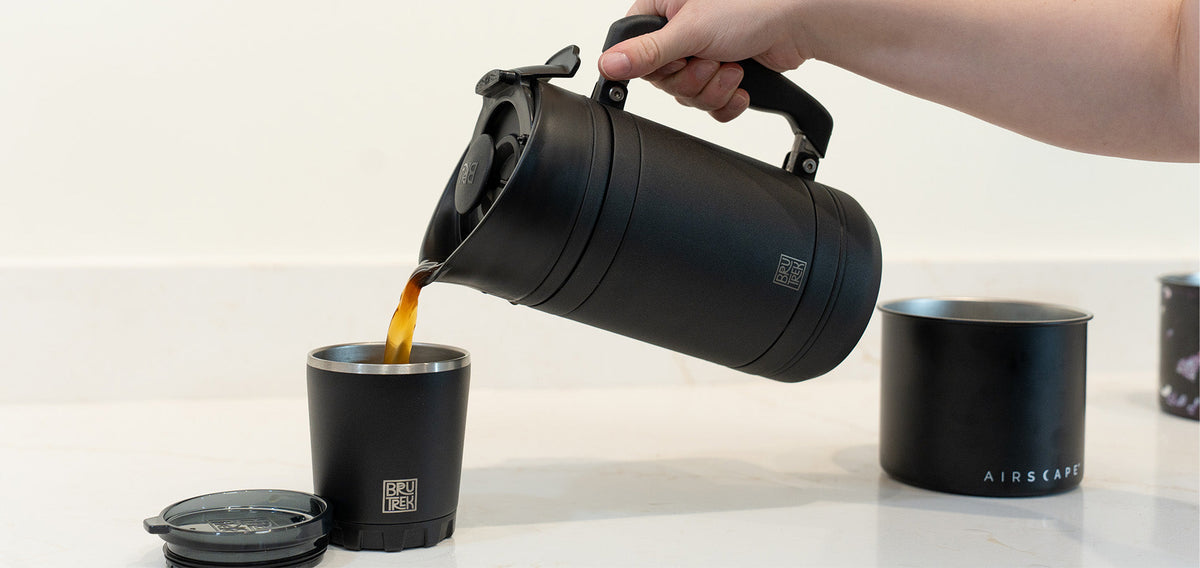
This is the specific problem our BruTrek® presses were designed around. Instead of a plain mesh screen, BruTrek® presses use a patented Bru-Stop® plunger, a flexible stainless steel plate with a silicone gasket around its edge.
When you press down, the plate travels to the bottom and the gasket seals against the inner wall. The grounds end up trapped beneath it, physically separated from the coffee above. With the grounds sealed off, the coffee you're drinking is no longer sitting on the grounds, so it isn't steadily pulling more bitterness out of them. The cup you pour an hour later tastes like the cup you poured first.
It also keeps sediment out of your mug. Fine particles that would normally drift through a mesh screen and settle as sludge at the bottom of your cup stay locked under the plate.
That's the whole idea: rather than asking you to change how you drink coffee, Bru-Stop® changes what happens after you press. Pair it with a double-wall, vacuum-insulated stainless body and you get coffee that stays hot for hours without stewing. You can see it across the line, from the 32 and 48 oz BaseCamp Camping French Press to single-serve travel presses like the Steel Toe 3.0.
Grind size is the biggest single lever you have. Finer grounds have far more surface area, so water extracts them faster. In a brewer where the grounds steep for minutes, a fine grind races straight past the sweet spot.
French press calls for a coarse grind, roughly the texture of coarse sea salt or breadcrumbs. If your grounds look like table salt or sand, that's very likely the source of your bitterness. You'll also notice more sludge in your cup and more resistance when you press. Our coffee grind size chart shows what each setting should look like by brew method.
Consistency matters as much as size. Blade grinders chop beans unevenly, producing a mix of boulders and dust. The dust over-extracts and turns bitter while the boulders under-extract and taste sour, so you get the worst of both in one cup. A burr grinder crushes beans to a uniform size. If you brew away from an outlet, the BruTrek® Hand Coffee Grinder is a stainless steel manual burr grinder that travels with the rest of your kit. For more on dialing it in, see our guide on how to grind coffee beans at home.
Boiling water poured straight onto grounds is the second most common cause of bitterness. Hotter water dissolves everything faster, including the compounds you don't want.
The widely used target is 195–205°F, the range Specialty Coffee Association guidance points to at the moment water meets the grounds. Seattle Coffee Gear's summary of the SCA Gold Cup Standard notes that below 195°F coffee under-extracts and tastes thin, while above 205°F bitter compounds extract too aggressively.
You don't need a thermometer to hit it. Bring water to a full boil, take it off the heat and wait about 30 seconds to a minute before pouring. At elevation, water already boils below 212°F, so you can pour sooner. We cover temperature in more depth in our pour over water temperature guide, and the same principles apply to the press.
Four minutes is the classic French press steep, and it's a good default for a coarse grind at the right temperature. Go much past five minutes and you're steadily pulling the bitter end of the extraction curve into your cup.
Use a timer. It's easy to pour water, get distracted packing the car or flipping eggs, and come back at eight minutes. If you like a stronger cup, add more coffee rather than steeping longer. More coffee gives you more flavor. More time gives you more bitterness.
If you're still getting bitterness at four minutes with a coarse grind, try three and a half. Our article on how long to steep French press coffee walks through how to adjust steep time for different roasts.
Ratio affects strength more than extraction, but it plays a role. Too little coffee for the amount of water means each ground gets over-worked, which can push a cup toward thin, bitter and harsh all at once. People often respond to a weak cup by steeping longer, which makes the bitterness worse.
A good starting point for French press is about 1:15, or one gram of coffee for every 15 grams of water. That's roughly 30 grams of coffee for 450 grams (about 15 ounces) of water. Adjust from there to taste. We've covered this in detail in French press coffee to water ratio and how much coffee for French press.
Sometimes, yes. Roast level is the big one. Darker roasts are more soluble and carry more roast-derived bitterness, so they over-extract more easily. If you love dark roasts, use a slightly coarser grind and a slightly shorter steep than you would for a medium roast.
Stale beans cause a different issue. Old coffee tends to taste flat, papery and dull rather than sharply bitter, but people often try to compensate by grinding finer or steeping longer, which drags in bitterness. Fresh beans give you flavor to work with, so you don't need to over-brew to find it.
Freshness comes down to oxygen. An Airscape® Classic Coffee Canister uses an outer lid to close the container and an inner lid that you push down directly onto the beans, forcing air out through a one-way valve as it goes. The valve lets air out but won't let it back in, so you remove oxygen instead of trapping it. No pumps, batteries or electricity. For the full picture, see how long coffee stays fresh.
Use this table to match what you taste with the most likely cause and the quickest fix.
| Cause | What you taste or notice | Quick fix | Where the press itself helps |
|---|---|---|---|
| Grind too fine | Harsh bitterness, heavy sludge, hard to press | Grind coarser, like coarse sea salt | Bru-Stop® keeps fines out of your cup |
| Water too hot | Sharp bitterness from the first sip | Wait 30–60 seconds off the boil | Insulation holds a steady brew temp |
| Steep too long | Dry, lingering bitterness | Set a timer for 4 minutes | Not applicable, timing is on you |
| Coffee left on grounds | First cup fine, later cups bitter | Decant immediately, or seal off grounds | Bru-Stop® separates grounds after pressing |
| Too little coffee | Thin and bitter at the same time | Use about 1:15 coffee to water | Not applicable |
| Very dark roast | Ashy, smoky bitterness | Coarser grind, shorter steep, or a medium roast | Not applicable |
| Stale beans | Flat, papery, dull | Buy smaller batches, store airless | Airscape® keeps beans fresher longer |
Leaving coffee in a standard press is the first and most common mistake. People brew a full 32-ounce pot, pour one mug, and leave the rest sitting on the grounds. By the time they come back, the remaining coffee has kept extracting and tastes noticeably worse. Either pour it all off right away or use a press that seals the grounds.
Pouring boiling water straight from the kettle is the second. It's the most natural thing in the world to do and one of the easiest ways to scorch the bright notes out of your coffee. Thirty seconds of patience fixes it.
Using pre-ground coffee meant for drip machines is the third. Most store-bought ground coffee is ground medium or medium-fine for automatic brewers, which is too fine for a steeped method. It over-extracts and clogs the plunger. If you buy pre-ground, look for a bag labeled for French press or coarse grind.
Stirring too aggressively or plunging too hard is the fourth. A gentle stir after you pour helps wet all the grounds evenly. Hard, repeated stirring and slamming the plunger down agitates fines into the coffee and can push extra bitterness into the cup. Press slowly and steadily.
Skipping cleaning is the fifth. Old coffee oils go rancid and build up on the plunger and walls, adding a stale, bitter edge to every fresh pot. Rinse after each use and do a full wash regularly. Our guide on how to clean a stainless steel French press covers the process.
Why is my coffee bitter even with good beans? Great beans can still over-extract if the grind is too fine, the water is too hot or the steep runs long. In a French press, coffee left sitting on the grounds after pressing is another common cause. Start by coarsening your grind and setting a four-minute timer.
How do you make coffee less bitter without adding sugar? Fix the extraction first: use a coarser grind, let boiling water rest 30 seconds to a minute, and stop the steep at about four minutes. A small pinch of salt can also mute bitterness on the tongue, but it's a patch rather than a fix. Switching from a dark roast to a medium roast often makes the biggest difference.
Is over-extracted coffee bad for you? Over-extracted coffee isn't unsafe. It simply tastes worse because more of the bitter, astringent compounds have dissolved into the cup. The fix is about flavor, not safety.
Why does my French press coffee taste bitter after 20 minutes? A standard mesh plunger doesn't stop extraction, so coffee sitting above the pressed grounds keeps pulling compounds from them. The longer it sits and the hotter it stays, the more bitter it gets. Decant right after pressing or use a press with a sealing plunger like Bru-Stop®.
Does a French press make more bitter coffee than drip? Not inherently. A well-dialed French press with a coarse grind and a four-minute steep can be rich and smooth. The difference is that a French press keeps grounds and coffee in contact, so it's less forgiving if you let it sit.
Bitter coffee almost always comes back to extraction. Too fine, too hot, too long or too much contact with the grounds after brewing, and the harsh compounds find their way into your cup. Get the grind coarse, let the water rest off the boil, time the steep and you've solved most of the problem.
The last piece is the one a recipe can't fix: what happens after you press. A standard plunger lets coffee keep brewing in the pot, so your second cup pays for your first. Sealing off the grounds ends that, whether you're pouring for a full campsite or sipping one mug through a long morning.
Explore the full BruTrek® collection of insulated stainless French presses and travel presses with patented Bru-Stop® technology, and keep every cup as smooth as the first.
Travel French Press Guide: How to Brew Great Coffee Anywhere
Why Is My Coffee Bitter? How to Fix Over-Extracted French Press Coffee
How to Keep Cheese From Molding: Paper, Plastic Wrap and Cheese Vaults Compared
How to Store Cheese in the Fridge: A Guide by Cheese Type
How to Reseal a Wine Bottle Without the Cork: Caps, Stoppers and Toppers Compared
Share:
How to Keep Cheese From Molding: Paper, Plastic Wrap and Cheese Vaults Compared
Travel French Press Guide: How to Brew Great Coffee Anywhere