






- by Madeline Staples
How to Brew Coffee While Camping: 7 Methods That Work
- by Madeline Staples
The best way to brew coffee while camping depends on your pack weight tolerance and brewing preference, but pour-over systems under three ounces and French presses deliver the most consistent flavor with minimal gear. After 15 years of crafting eco-friendly houseware and adventure-brewing equipment in Montana, we've tested these methods across a range of settings, from alpine camps to desert overlanding trips.
This guide walks you through seven reliable brewing methods for camp coffee, comparing weight, durability, and actual taste results. You'll learn which systems work for solo backpackers versus group camping, how to match your home goods brewing style to backcountry conditions, and what gear holds up when you're miles from the trailhead.
We cover ultralight pour-over setups, French press techniques that won't break on rocky ground, percolator basics for larger groups, and why 2026 testing across six states confirms certain methods consistently outperform others.
Your camping coffee setup starts with an honest assessment of how much weight you're willing to carry and how many people you're brewing for. A solo backpacker counting ounces needs different gear than a family camping from an RV.
Pour-over systems weigh as little as 0.8 ounces and pack flat, making them ideal for backpacking trips where every ounce matters. The COLETTI Sierra represents the current ultralight standard, fully plastic-free and nearly weightless in your pack. Our ethoz® pour-over brewer offers similar compact efficiency with a collapsible design that doesn't sacrifice brewing control.
French presses work better for groups of two to four people. The AeroPress weighs 16.5 ounces and packs to water-bottle size, earning top marks in 2026 testing across Colorado, Idaho, Minnesota, New York, Washington, and Wyoming. It brews espresso-style shots, French press coffee, and cold brew without electricity, genuine versatility for camp conditions.
Percolators handle larger groups efficiently. The GSI Outdoors Enamelware Percolator brews six cups in four to eight minutes, making it the fastest option when you're feeding a hungry camp. You'll need coarse grounds and a stove that maintains steady heat.
Instant coffee remains the lightest option at a fraction of an ounce, though the flavor suffers. Cowboy coffee requires only a pot and grounds, no specialized gear, but you'll deal with sediment in your cup unless you're careful with your pour.
Start with fresh coffee grounds stored properly. Stale coffee tastes worse at camp than it does at home; altitude and cold temperatures amplify flavor flaws. Our Airscape® storage canisters use a patented valve system that forces air out and locks in freshness, preserving your beans during multi-day trips when resupply isn't an option.
You'll need a reliable heat source. Camp stoves, Jetboil systems, or campfire coals all work, but your brewer determines which option makes sense. Pour-over and French press methods require pre-boiled water, while percolators sit directly on heat.
Bring a kettle or pot that holds enough water for your brewing method. Pour-over typically needs 12 to 16 ounces per cup, French presses require filling the chamber completely, and percolators need water plus headspace for percolation.
Pack filters appropriate to your method. Paper filters deliver cleaner cups with less sediment, but reusable stainless steel home goods like filters eliminate backcountry waste, a significant shift in 2026 outdoor brewing trends. The ethoz® line includes permanent filters that rinse clean at camp and don't add paper taste.
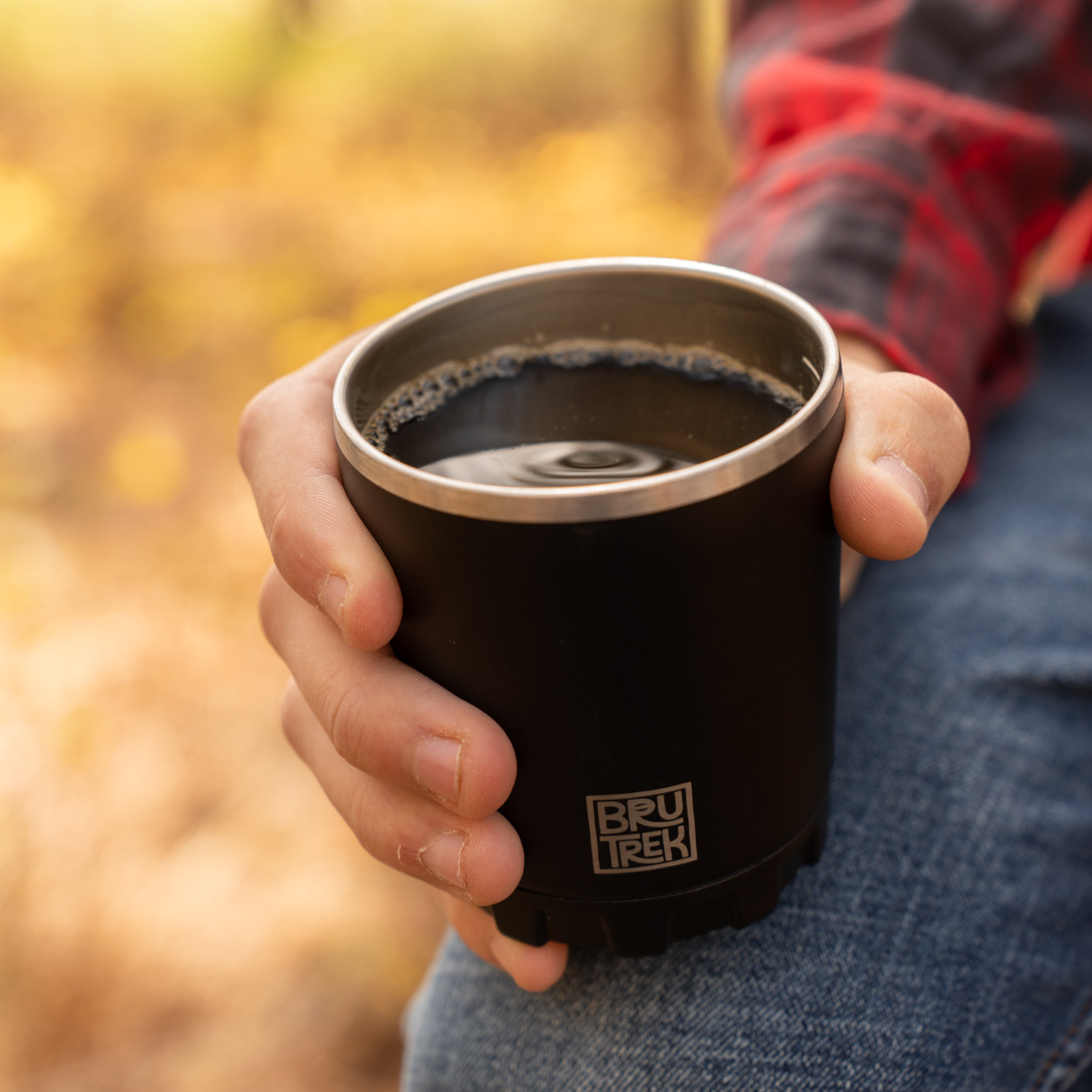
Don't forget a mug that keeps coffee hot. Our BruTrek® adventure drinkware is designed specifically for backcountry conditions, with double-wall insulation, leak-proof lids, and durability that survives getting knocked off a camp table onto rocky ground.
Water temperature directly affects extraction and flavor. The Specialty Coffee Association confirms optimal brewing occurs between 200°F and 210°F (90°C to 96°C). Boiling water reaches 212°F at sea level, dropping to around 203°F at 6,000 feet elevation due to lower atmospheric pressure.
Boil your water fully, then let it rest off heat for 30 seconds. This brings the temperature into the ideal range without requiring a thermometer at camp. You'll notice the difference in taste: water that's too hot extracts bitter compounds, while water that's too cool produces weak, sour coffee.
Cold weather camping requires extra attention. Your water cools faster in freezing temperatures, so minimize the time between boiling and brewing. Pre-warming your brewer with a quick rinse of hot water helps maintain temperature during extraction.
High-altitude campers should note that water boils at lower temperatures as elevation increases. At 10,000 feet, water boils at 194°F, which is below the optimal brewing temperature. Compensate by using slightly finer grounds or extending brew time to achieve proper extraction.
Use two level tablespoons of ground coffee per six ounces of water as your baseline ratio. This approximates the standard 1:16 coffee-to-water ratio by weight (one gram of coffee per 16 grams of water) without requiring a scale at camp.
Adjust based on your taste preference and altitude. Higher elevations often require slightly more coffee grounds since water boils at lower temperatures and extracts less efficiently. Start with the baseline ratio, then increase by half a tablespoon if your first cup tastes weak.
Grind size matters significantly. Coarse grounds work for French press and percolator methods, preventing over-extraction and reducing sediment. Medium grounds suit pour-over brewers. Fine grounds are appropriate only for espresso-style devices like the Wacaco Minipresso GR, which pumps a shot in one minute and 20 seconds.
Pre-measure your coffee at home for multi-day trips. Store daily portions in small containers or bags to simplify morning brewing when you're barely awake. The Airscape® system's modular sizing lets you portion coffee for trip length without carrying excess weight.
Place your pour-over brewer on top of your mug and insert a filter. If using paper, rinse it with hot water first to remove the paper taste, then pre-warm the brewer. Discard the rinse water.
Add your measured coffee grounds to the filter and create a small well in the center. This helps water distribute evenly during the bloom phase.
Pour just enough hot water to saturate all the grounds, roughly twice the weight of your coffee. Let this bloom for 30 to 45 seconds. You'll see the grounds expand and release carbon dioxide, which improves extraction and flavor clarity.
After blooming, pour the remaining water in a slow, circular motion, starting from the center and spiraling outward. Maintain a steady, thin stream rather than dumping water all at once. The entire pour should take two to three minutes for a standard cup.
The ethoz® pour-over system collapses to a pack size while maintaining the wide brewing cone that professional baristas prefer. This geometry allows proper water flow and extraction even when you're brewing on uneven ground at camp.
Add your coarse-ground coffee to the bottom of the French press. The grounds should look like coarse sea salt; too fine and you'll get sludge in your cup, too coarse and extraction suffers.
Pour hot water over the grounds, filling the press about halfway. Stir gently with a spoon or stick to ensure all grounds are saturated, then add the remaining water to fill the chamber. Place the lid on top with the plunger pulled all the way up.
Let the coffee steep for four minutes. This timing produces balanced extraction; less time yields weak coffee, more time creates bitter, over-extracted results. Set a timer if you have one, or count slowly to 240.
Press the plunger down slowly and steadily. If you meet significant resistance, your grind is too fine. If the plunger drops with no resistance, your grind is too coarse. Proper grind creates gentle, even pressure as you press.
Pour immediately after pressing. Leaving coffee grounds sitting in the pot continues extraction and turns your brew bitter. The ESPRO P0 Ultralight Travel French Press functions as both brewer and travel mug, letting you drink directly without transferring to another container.
Percolators work well for large groups camping with vehicle access. Add coarse grounds to the basket, fill the bottom chamber with cold water, and place the percolator directly on your camp stove. The water will boil, rise through the tube, and percolate through the grounds. You'll see coffee bubbling in the glass knob on top; brew for 4 to 8 minutes, depending on the desired strength.
Cowboy coffee requires only a pot and patience. Add two tablespoons of coarse grounds per cup directly to your pot of cold water. Bring to a boil, then remove from heat and let sit for four minutes. The grounds will settle to the bottom. Pour slowly and carefully, leaving the last inch of coffee in the pot to avoid drinking grounds.
The Bialetti Moka Express brews espresso-style coffee directly on your camp stove without pre-boiling water. Fill the bottom chamber with cold water, add finely ground coffee to the filter basket, and assemble. Place on medium heat until you hear gurgling; coffee will rise into the top chamber in about five minutes.
Instant coffee works when weight is critical, or you're too exhausted to brew properly. Modern instant options have improved significantly, though they'll never match the flavor of freshly ground coffee. Store instant packets in a waterproof container and add hot water directly to your mug.
Rinse your brewer immediately after use. Coffee oils turn rancid quickly, especially in warm weather, and stale oils ruin the flavor of your next cup. Most brewing methods rinse clean with hot water and a quick scrub.
Pack a small brush or sponge specifically for coffee gear. French press filters trap oils in their mesh screens, and pour-over brewers accumulate residue in tight corners. A dedicated cleaning tool prevents cross-contamination with food flavors.
Dry everything completely before packing. Moisture breeds mold and mildew in your pack, and metal components can rust. Shake out excess water and air-dry your gear while you're breaking down the rest of camp.
Store grounds in airtight containers between brews. The Airscape® valve system is patent-protected to remove air and lock in freshness, which is critical when your coffee sits in a pack for days between uses. Oxygen is coffee's enemy, and backcountry conditions accelerate staling.
Inspect your gear regularly for damage. French press glass can crack from temperature shock if you pour boiling water into a frozen press. Metal components can dent or bend when packed carelessly. Catching damage early prevents a broken brewer miles from your vehicle.
Pour-over systems under three ounces offer the best weight-to-quality ratio for backpacking. The COLETTI Sierra weighs 0.8 ounces and brews excellent coffee without plastic components. Pair it with pre-measured coffee portions and a titanium mug to keep your entire setup under four ounces excluding your stove and fuel.
Let your pot sit undisturbed for four full minutes after removing from heat. The grounds will settle to the bottom naturally. Pour slowly and stop before you reach the last inch of coffee in the pot. Some campers add a splash of cold water after brewing to speed settling, though this isn't necessary if you're patient.
Regular coffee grounds work perfectly for camping; no special formulation required. Focus on grind size appropriate to your brewing method: coarse for French press and percolator, medium for pour-over, fine for espresso devices. Store the grounds in an airtight container, such as the Airscape® system, to maintain freshness during your trip.
Percolators handle groups most efficiently when weight isn't a concern. The GSI Outdoors Enamelware Percolator brews six cups in under eight minutes and works on any camp stove or campfire. French presses also work well for families, brew multiple batches quickly, and are nearly indestructible when made from stainless steel.
Brew directly into an insulated mug with a tight-sealing lid. Double-wall vacuum insulation keeps coffee hot for hours even in freezing temperatures. The BruTrek® line is specifically designed for backcountry conditions, with leak-proof construction and insulation that actually performs when you're miles from warmth. Pre-warming your mug with hot water before brewing also helps maintain temperature.
Reliable camp coffee comes down to matching your brewing method to your trip style, using fresh, properly stored grounds, and consistently executing basic technique. Pour-over systems work for ultralight backpackers, French presses suit small groups, and percolators handle larger camps efficiently.
The 2026 shift toward reusable filters and plastic-free gear reflects what we've known for 15 years in Montana: durable, well-designed equipment performs better and creates less waste in the backcountry. Our Airscape® storage keeps your coffee fresh for the entire trip, the ethoz® pour-over collapses to pack size without sacrificing brewing quality, and BruTrek® drinkware maintains temperature when you're far from the trailhead.
Start with the two-teaspoon-per-cup baseline, adjust for your taste and altitude, and pay attention to water temperature. These fundamentals matter more than expensive gear. Visit our collection of adventure brewing equipment designed specifically for conditions where reliability isn't optional; it's essential.
Can You Store Coffee and Cannabis Together? A Side-by-Side Storage Guide
Caffeine and Cannabis: What the Research Actually Says
How to Store Pre-Rolls So They Don't Dry Out
How to Store Dry Dog Food: Keep Kibble Fresh to the Last Scoop
Sustainable Food Storage Containers That Actually Work
Share:
How Much Coffee for French Press: Perfect Ratios for 2026
Pour Over Coffee Maker vs French Press: Which Brews Better?