






- by Madeline Staples
Pour Over Coffee Maker vs French Press: Which Brews Better?
- by Madeline Staples
Pour-over coffee makers produce a cleaner, lighter cup with bright, nuanced flavors, while French presses deliver a fuller, richer brew with more body and natural oils. Your choice depends on whether you prefer clarity or boldness in your morning cup.
This guide is for coffee enthusiasts who want to understand how these two popular brewing methods actually differ, not just in process, but in the cup they produce. Whether you're brewing at your kitchen counter or at a remote cabin, we'll help you match the right method to your taste preferences and lifestyle, along with coffee bean storage tips to keep your brew fresh.
The fundamental difference lies in how water interacts with coffee grounds. Pour-over uses gravity-fed percolation through a paper or metal filter, while the French press relies on full immersion followed by plunger separation.
With pour-over brewing, you control the water flow rate as it passes through grounds in a cone or flat-bottom dripper. The filter, typically paper (though metal options exist), removes oils and fine particles as water extracts soluble compounds. This method demands attention to your pouring technique and water temperature, making it a more hands-on process.
French press brewing submerges all the grounds in hot water for 3-5 minutes before pressing a metal mesh filter down to separate them. The mesh allows natural oils and some fine particles to remain in your cup, creating a different texture and flavor profile. You add water, wait, press, and pour; no special pouring technique required.
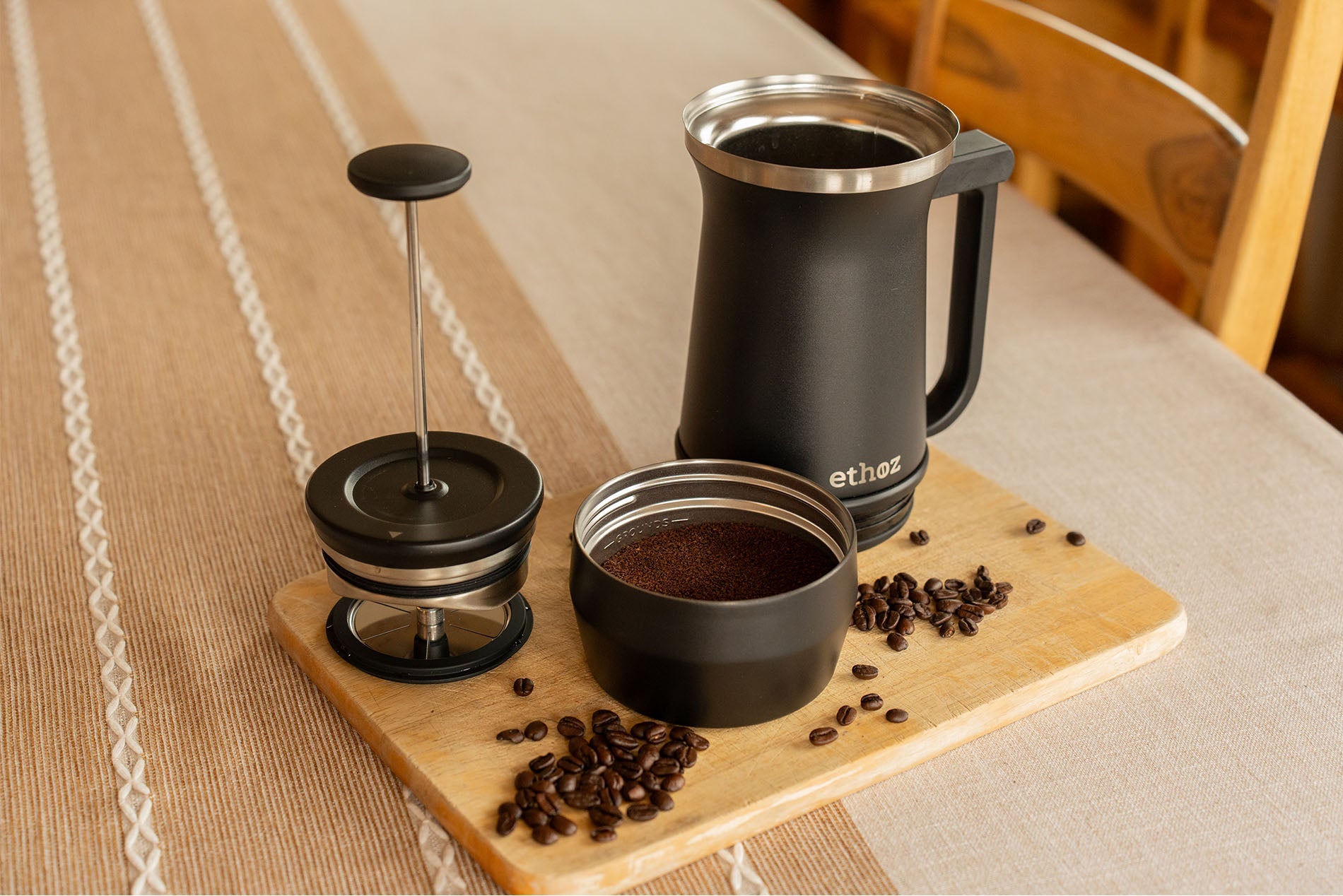
At Planetary Design, we've spent 15+ years refining brewing methods to enhance durability and performance. Our ethoz® pour-over brewers feature precision-engineered flow channels that work consistently whether you're at home or in the backcountry. Our French presses use double-wall insulation to maintain temperature during the brew cycle, critical when you're brewing outdoors where ambient temperatures can steal heat quickly.
Pour over coffee tastes cleaner, brighter, and more tea-like, with individual flavor notes standing out distinctly. French press coffee tastes bolder, richer, and fuller-bodied, with a velvety mouthfeel that coats your palate.
The paper filter in pour-over brewing removes nearly all coffee oils and most fine particles. This creates what coffee professionals call clarity; you can identify specific tasting notes such as citrus, berry, or floral notes. Light and medium roasts shine with this method because their delicate flavors aren't masked by oils or sediment. The cup feels clean in your mouth, almost like a refined tea.
French press brewing keeps those natural oils in your cup because the metal mesh filter can't trap them. These oils carry flavor compounds and create body, that substantial, almost thick sensation on your tongue. You'll taste chocolate, caramel, and nutty notes more prominently. Darker roasts work beautifully here because the method emphasizes their bold, comforting qualities rather than revealing any bitterness that paper filters might expose.
According to 2026 industry analysis, experts consistently emphasize that neither method is objectively better; they produce fundamentally different cups suited to different preferences. Pour over reveals nuance and complexity in single-origin beans, while French press delivers the rich comfort many coffee drinkers crave in their morning ritual.
|
Characteristic |
Pour Over |
French Press |
|
Body |
Light to medium, clean mouthfeel |
Full, rich, velvety texture |
|
Oils |
Removed by paper filter |
Retained in cup |
|
Clarity |
High, individual notes distinct |
Lower, blended, bold flavor |
|
Best For |
Light/medium roasts, single-origin |
Medium/dark roasts, blends |
|
Flavor Profile |
Bright, nuanced, tea-like |
Bold, rich, comforting |
French press is more forgiving and simpler for beginners: add grounds, pour water, wait four minutes, press, and pour. Pour over requires more attention to technique, particularly your pouring speed and pattern, to achieve consistent results.
With French press, you can't mess up much. Use a coarse grind, add water just off boil, set a timer, and press when it beeps. The immersion method means all grounds extract evenly regardless of how you added the water. You're brewing multiple cups at once, making it practical when you're serving a group or want a full carafe for yourself.
Pour over demands what coffee professionals call mindful brewing. You need to control your pour rate; too fast and you'll under-extract (weak, sour coffee), too slow and you'll over-extract (bitter, harsh coffee). The spiral pouring technique, in which you move in concentric circles from the center to the edge, ensures even saturation. Water temperature matters more here because you're adding it gradually rather than all at once.
That said, pour over is easier to clean. Lift out the paper filter with grounds, toss it, rinse the dripper. Done in 30 seconds. French press cleanup means disassembling the plunger, rinsing the carafe, and fishing grounds out of the mesh filter, grounds that tend to stick stubbornly to every surface they touch.
Pour over uses medium to medium-fine grounds, similar to granulated sugar. French press needs coarse grounds, like sea salt or breadcrumbs. Using the wrong grind size creates problems: fine grounds in a French press make sludgy, over-extracted coffee, while coarse grounds in a pour-over produce a weak, under-extracted brew.
You'll need a decent burr grinder for either method. Blade grinders produce inconsistent particle sizes, leading to uneven extraction. We've found that investing in a quality grinder matters more than the brewing device itself; you can make excellent coffee with a $20 dripper and a $100 grinder, but not the reverse.
French press takes 4-5 minutes of passive time; you're not doing anything while coffee steeps. Pour-over takes 2.5-4 minutes of active time, during which you control the water flow throughout the process.
French press fits better into a morning routine where you're multitasking. Start the brew, make breakfast, press when the timer goes off. You're brewing 3-8 cups at once, so everyone gets coffee from one batch. The thermal mass of that much liquid also means it stays hot longer in the carafe.
Pour over works better when you want a single perfect cup and have three minutes to focus on it. You're standing there with your kettle, pouring in stages, paying attention. It becomes a morning ritual; some people find this meditative, others find it tedious. You're typically brewing one or two cups at a time unless you're using a large Chemex-style dripper.
For outdoor brewing, we've designed our BruTrek® line to handle both methods in challenging conditions. Our travel French press maintains temperature in cold environments, while our pour-over system remains stable on uneven surfaces, critical when you're brewing on a camp table or tailgate. After 15 years of testing in Montana backcountry, we've learned that durability matters more than features when you're miles from anywhere.
Both methods cost roughly $20- $ 150, depending on materials and design, making them equally accessible starting points for manual brewing. French press tends to be slightly cheaper at entry level, while high-end pour-over drippers can reach premium prices.
A basic plastic pour-over dripper costs $8-15. Ceramic or glass versions run $20-40. Specialty designs with advanced flow channels or double-wall construction reach $50-150. You'll also need filters; paper filters cost $5-10 for 100, while reusable metal filters run $15-25 as a one-time purchase.
French presses start around $20 for basic glass models and reach $100-150 for double-wall stainless steel or advanced filtration systems. You're not buying ongoing filters, which saves money over time. However, you might replace the mesh filter assembly every year or two if the ground damages it.
The bigger cost factor is your grinder. A decent burr grinder starts at $40 for manual models and $100+ for electric. This matters equally for both methods, so it's not a differentiator between them.
Pour-over drippers last indefinitely if you choose ceramic, metal, or durable plastic. Glass French presses break; we've seen countless shattered carafes from minor bumps or temperature shock. Stainless steel French presses solve this problem and can last decades.
Our ethoz® pour-over brewers use advanced polymers and ceramics that withstand drops, temperature swings, and UV exposure. They're designed for travel and outdoor use, not just kitchen counters. Similarly, our French presses feature double-wall stainless steel construction that survives the kind of treatment that would destroy glass versions; we've had customers report using the same unit through five years of regular camping trips.
Pour over excels with light and medium roasts, especially single-origin beans where you want to taste specific regional characteristics. French press works better with medium to dark roasts and blends where you're seeking bold, comforting flavors.
Light roasts contain delicate acids and floral notes that paper filters allow to shine. Ethiopian coffees with blueberry notes, Kenyan coffees with bright citrus, Central American coffees with apple-like acidity- these reveal their complexity through pour-over. The clean cup lets you taste what makes each origin unique.
Darker roasts develop chocolate, caramel, and toasted nut flavors during roasting. These compounds are less volatile and benefit from the oils that French press retains. A dark Brazilian blend or Indonesian coffee with earthy, spicy notes tastes richer and more satisfying, thanks to the body that a French press provides.
That said, these are guidelines, not rules. Some people love the brightness pour over brings to dark roasts. Others enjoy the full body French press gives to light roasts. Experiment with your favorite beans using both methods; you might discover you prefer one method for your morning cup and another for afternoon coffee.
Regardless of brewing method, fresh beans make the biggest difference in your cup. Coffee starts losing flavor within weeks of roasting as volatile compounds escape and oils oxidize.
Our Airscape® storage system uses a patented valve mechanism to remove air from the container after each use. Air contains oxygen and moisture, the two elements that degrade coffee fastest. By pushing air out with the inner lid, you're removing what causes staleness. This matters whether you're brewing pour-over or French press, because both methods only extract what's present in the beans. Stale beans produce flat, cardboard-like coffee no matter how perfect your technique, and the same principle applies to dry food storage of any kind.
Pour-over drippers are more portable; they're typically smaller, lighter, and less fragile than French presses. A collapsible silicone dripper weighs two ounces and fits in any pack pocket.
For backpacking, bikepacking, or van life, pour-over wins on weight and packability. You need the dripper, filters, and a way to heat water. Everything except the kettle weighs under half a pound. Our ethoz® travel pour-over system collapses to 1.5 inches thick and weighs just seven ounces including the base.
French press requires more space and protection. Glass carafes need padding to prevent breakage. Even stainless steel models are bulkier and heavier, typically 12-20 ounces empty. However, they offer an advantage when you're car camping or staying in a cabin: you can brew for multiple people at once without making several individual cups.
We designed our BruTrek® French press specifically for adventure use. The double-wall stainless construction eliminates breakage concerns, and the insulation keeps coffee hot during the brew cycle even in cold conditions. At 14 ounces, it's not ultralight, but it's practical for any trip where weight isn't the primary constraint.
Pour-over cleanup takes 30 seconds: lift out the filter with the grounds, toss it, and rinse the dripper. French press cleanup takes 2-3 minutes and requires more effort to remove grounds from the mesh filter and carafe.
With pour over, you're dealing with a contained filter that holds all the grounds. If you're using paper filters, it goes straight to compost or trash. Metal filters need a quick rinse under running water. The dripper itself rarely has stuck grounds because the filter prevented contact.
French press grounds get everywhere. They stick to the mesh filter, coat the inside of the carafe, and somehow end up on the plunger shaft. You need to disassemble the plunger to clean it properly, which means unscrewing parts and rinsing each piece. Grounds in the sink can clog drains, so many people dump them in the trash or compost first, adding another step.
In outdoor settings without running water, pour-over is significantly easier. You can compost the filter and grounds, then wipe the dripper with a cloth. French press requires more water for rinsing and creates a messier cleanup process when you're working at a camp sink or stream.
French press doesn't make stronger coffee; it makes bolder, fuller-bodied coffee due to the retention of oils and fine particles. Strength comes from your coffee-to-water ratio, which you control equally with both methods.
Coffee strength means the concentration of dissolved solids in your cup. You can make a strong pour-over by using more coffee grounds or less water. You can make a weak French press by using too few grounds or too much water. The brewing method affects flavor profile and body, not strength.
That said, French press often tastes stronger because the oils and fine particles create more body and a lingering finish. Your brain interprets that fuller mouthfeel as intensity. Pour-over can taste lighter or weaker, even at the same actual strength, because it lacks body.
For reference, a typical ratio is 15-17 grams of water per gram of coffee. Use 30 grams of coffee with 500 grams of water for either method, and you'll get similar strength but different flavor profiles. Adjust the ratio to match your preference; we typically use 16:1 for pour over and 15:1 for French press to account for the different extraction characteristics.
Both methods are thriving in 2026 as part of what industry analysts call the "Year of the Manual Brew", a cultural shift from rushed mornings to intentional coffee rituals. Pour-over appeals to those seeking customization and precision, while French press appeals to those seeking simplicity and bold comfort.
The manual brew resurgence reflects a broader move away from pod machines and automated drip coffee makers. People want connection to their coffee, understanding where it comes from, how it's processed, and how brewing choices affect the cup. This aligns with the third-wave coffee movement, which has driven the pour-over market from $1.2 billion in 2024 to a projected $2.3 billion by 2033.
Recent product developments show both methods evolving. Pour-over drippers now feature refined internal ribbing and directed flow channels for more consistent extraction. French presses have improved filtration systems that reduce sediment while maintaining the oils that create body. Manufacturers are also focusing on eco-friendly materials, recycled glass, sustainably sourced ceramics, and durable polymers that replace single-use pod waste.
At Planetary Design, we see this trend reflected in our Conservation Alliance partnership and commitment to the Boundary Waters protection legislation. Coffee enthusiasts who choose manual brewing often care deeply about environmental impact. They're avoiding pod waste, buying quality equipment that lasts decades, and supporting brands that take concrete conservation action. Your choice to brew manually, whether pour over or French press, already puts you in this community.
No, neither method produces true espresso. Espresso requires 9+ bars of pressure to force water through finely ground coffee in 25-30 seconds, creating the concentrated shot and crema that define espresso. Both pour-over and French press brewing use atmospheric pressure, producing regular coffee. However, you can make strong coffee with either method by increasing your coffee-to-water ratio; it just won't have espresso's unique characteristics.
French press is more forgiving for beginners because it requires less technique. Add coarse grounds, pour hot water, wait four minutes, press, and pour; you can't mess it up much. Pour over demands attention to pouring speed and pattern, which takes practice to master. However, pour over is easier to clean, which some beginners prefer. Start with whichever method appeals to you; both produce excellent coffee once you learn the basics.
For pour-over, bitter coffee usually means you're pouring too slowly or using water that's too hot, which causes over-extraction. Pour faster, use water at 195-205°F, and make sure your grind isn't too fine. For French press, bitterness comes from steeping for too long or using a grind that's too fine. Stick to a maximum steep time of 4 minutes and use coarse grounds. With both methods, fresh beans matter; stale coffee tastes bitter regardless of technique.
No, pour over needs medium to medium-fine grounds while French press requires coarse grounds. Using French press grounds in pour over creates weak, under-extracted coffee because water flows through too quickly. Using pour-over grounds in French press makes sludgy, over-extracted coffee and clogs the mesh filter. You need to adjust your grinder setting when switching between methods; this is why a quality burr grinder with consistent settings matters.
A French press keeps coffee hotter because you're brewing a larger volume of coffee in an insulated carafe. Thermal mass helps maintain temperature, and double-wall stainless steel models provide excellent heat retention. Pour over brews directly into your cup or a separate carafe, and the small volume cools faster. However, pour-over lets you brew fresh cups as needed rather than keeping a carafe warm, which some people prefer to maintain flavor quality.
Pour over delivers clarity, brightness, and nuanced flavors that reveal what makes your coffee unique. French press offers bold richness, full body, and comforting depth that emphasizes coffee's satisfying qualities. Neither is better; they're different tools for different taste preferences and situations.
Try both methods with your favorite beans. Brew the same coffee using pour-over one morning and French press the next. Notice which characteristics you prefer: clean and tea-like versus rich and velvety. Consider your routine: do you want a meditative ritual or a simple process? Think about your typical brewing scenario: single cups at home, multiple servings for guests, or portable outdoor brewing.
At Planetary Design, we've spent 15 years refining both brewing methods for people who refuse to compromise quality anywhere they brew. Our ethoz® pour-over system and BruTrek® French press are built for the durability that Montana backcountry demands, using patent-protected designs that work consistently whether you're at your kitchen counter or a remote campsite. Pair either brewer with our Airscape® storage to keep your beans fresh between brewing sessions, because the best brewing method in the world can't fix stale coffee. Explore our brewing gear designed for adventure and built to last decades, not seasons.
Can You Store Coffee and Cannabis Together? A Side-by-Side Storage Guide
Caffeine and Cannabis: What the Research Actually Says
How to Store Pre-Rolls So They Don't Dry Out
How to Store Dry Dog Food: Keep Kibble Fresh to the Last Scoop
Sustainable Food Storage Containers That Actually Work
Share:
How to Brew Coffee While Camping: 7 Methods That Work
How to Store Coffee Beans Properly: Keep Them Fresh Longer